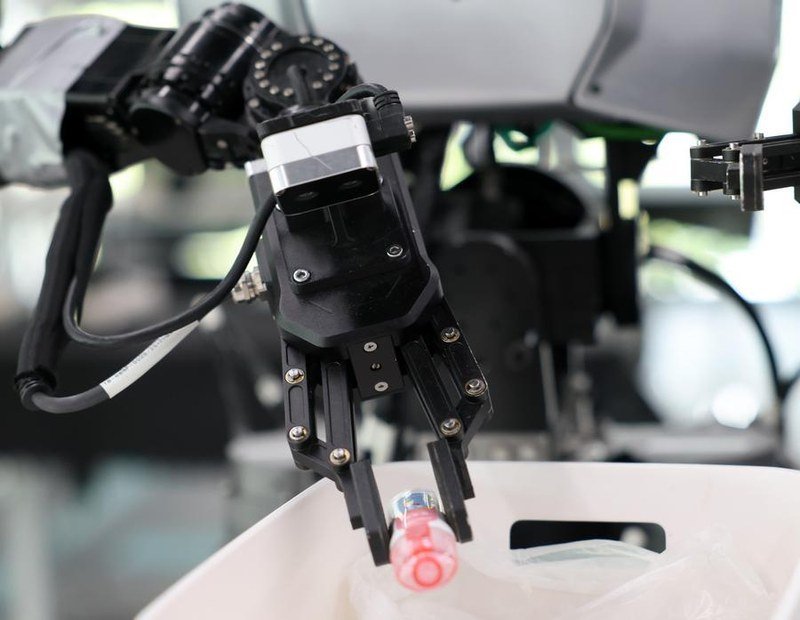
Robots are still bad at picking things up. Eka Robotics says it has built the exception: a manipulation architecture combining a force-sensitive gripper with a new kind of deep-learning model, and investors have just priced that claim at $1.45 billion. The startup closed a $150 million Series A led by a16z and F-Prime at a $1.45 billion post-money valuation, TechCrunch reported Tuesday.
Eka was founded by MIT professor Pulkit Agrawal and former Google DeepMind researcher Tuomas Haarnoja. Its robots, the company and its backers say, are already exceeding human performance on certain dexterous tasks. 'They are already exceeding superhuman performance for certain tasks, and so we think over the next few months there will be superhuman performance in many dexterous manipulation tasks,' said Raghu Raguram, the a16z general partner who co-led the round.
Veteran roboticists who have seen the system use unusually strong language. Kris Hauser, a professor at the University of Illinois Urbana-Champaign, said the demo had a 'wow factor' compared with other robots he saw recently, noting the machine 'was able to adapt to a large number of different objects without retraining' and kept retrying when it failed — a quality he called a 'humanness, creepy humanness.' Another roboticist at a frontier lab, speaking anonymously, compared seeing it to the moment robots first achieved reliable legged locomotion.
The funding underscores where artificial intelligence money is moving: out of pure software and into physical AI — models that perceive and manipulate the real world. If Eka's system generalizes the way its demonstrations suggest, the bottleneck for warehouse, factory and laboratory automation shifts from hardware to deployment.